

Is Vci Liquid Suitable for Use on Photovoltaic Mounting Bracket Connectors?
2026-01-26 10:43In the photovoltaic industry, many problems often don't stem from the equipment itself, but from seemingly insignificant details that determine its lifespan. Photovoltaic mounting system connectors are a typical example: small in size and low in price, but once they corrode, the problems they cause are significant. So the question is – is high concentrated vci oil suitable for photovoltaic mounting system connectors? Is it necessary? How can it be used reliably?
Why is rust prevention essential for photovoltaic mounting system connectors?
Let's start with a common but often underestimated fact in the industry:
Photovoltaic mounting system connectors are almost always exposed to environments most prone to rust.
They are mostly exposed outdoors, facing not just a single condition, but multiple overlapping factors:
High humidity, diurnal temperature variations, rain, salt spray (especially in coastal or Southeast Asian regions), dust, and the stress concentration inherent in the metal itself. Many projects show no problems during the initial installation, but after six months or a year, corrosion begins to quietly appear at the connection points.
Based on our experience serving photovoltaic customers over the years, the real headaches for customers are often not the main support structures, but rather the bolts, connecting plates, and angle brackets – these small parts are the first to fail.
And these problems, once they occur in a power plant that is already connected to the grid, will infinitely increase maintenance costs.
It is based on this real-world feedback that CVCI has always focused on connectors in its research and development of rust prevention solutions for the photovoltaic industry.
What are the actual effects of high concentrated vci oil on photovoltaic mounting system connectors?
Many customers initially have questions: Is high concentrated vci oil really reliable? Will it only be effective in the short term?
This is a very practical question. The answer is: with the right type and application method, high concentrated vci oil is very suitable for photovoltaic mounting system connectors.
The biggest advantage of VCI high concentrated vci oil is that it's not a "thick-coating" traditional protection, but rather forms an extremely thin, uniform, and controllable protective film.
For photovoltaic mounting system connectors, this is crucial:
It does not affect thread fit and assembly accuracy.
It does not attract dust like grease.
It does not require complex cleaning later.
It is very suitable for processing small parts in batches.
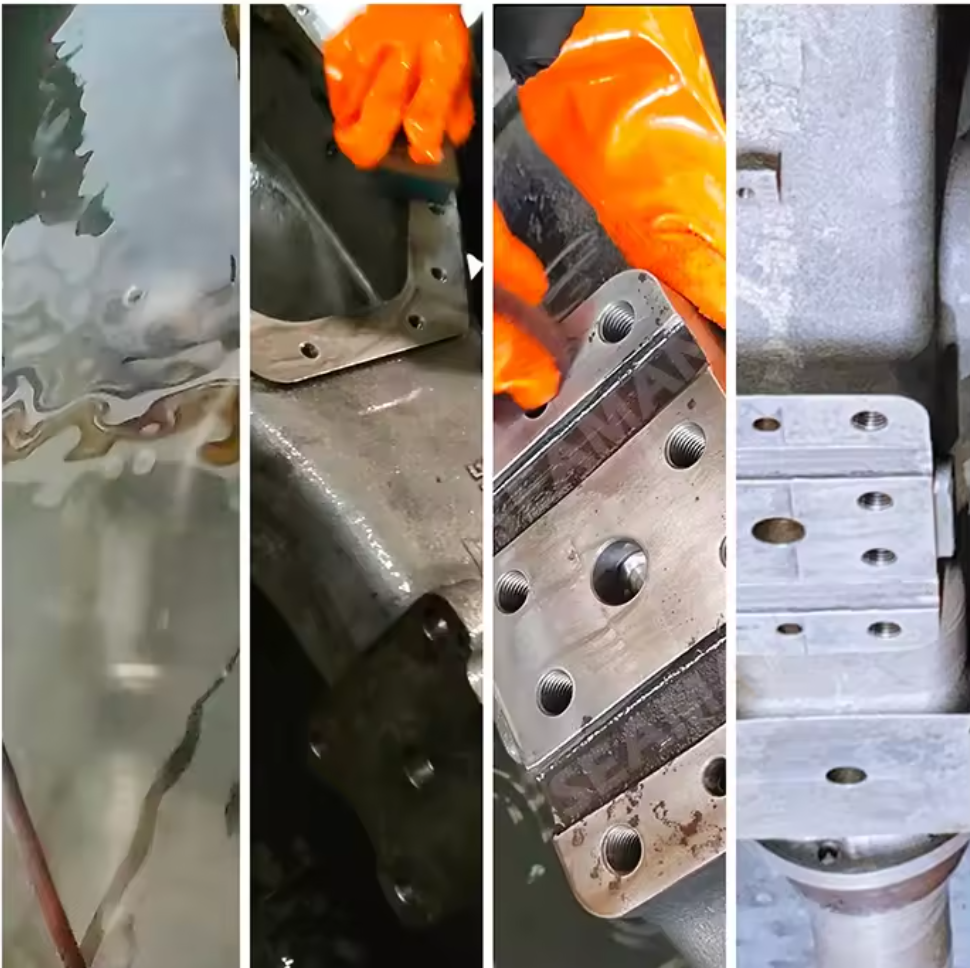
In actual projects, CVCI often provides customers with spraying, dipping, or atomization treatment solutions, customized according to the size, material, and transportation cycle of the connectors. Especially for photovoltaic projects exported to Southeast Asia, the stability of VCI high concentrated vci oil in high-humidity and high-temperature environments has been proven in multiple projects.
How exactly does VCI high concentrated vci oil work?
Many people are not familiar with the concept of "VCI," but understanding it is not difficult.
The core principle of VCI high concentrated vci oil is volatile corrosion inhibition technology.
After the high concentrated vci oil treatment is completed, the corrosion inhibitors in it will be slowly released in a closed or semi-closed environment, forming a molecular-level protective barrier on the metal surface.
The function of this barrier is not to isolate air, but to inhibit the electrochemical reaction between the metal and moisture and oxygen, thereby reducing the probability of corrosion at the source.
In CVCI's R&D system, we have conducted a large number of formula adaptation tests for common carbon steel, galvanized parts, and alloy steel connectors used in photovoltaic brackets, ensuring that the high concentrated vci oil can form a stable film on different metal surfaces without adverse reactions.
This is why our high concentrated vci oil can be continuously exported to many countries in Southeast Asia and used in local high-humidity projects for a long time.
Why is high concentrated vci oil more suitable for photovoltaic projects than other solutions?
In terms of anti-corrosion methods, the photovoltaic industry has actually tried many approaches:
Anti-corrosion oil, anti-corrosion grease, hot-dip galvanizing, wax sealing, and even direct exposure.
However, from the perspective of long-term use and overall cost, VCI anti-corrosion oil has several very practical advantages:
Suitable for large-scale processing of standard parts
Does not increase additional structural thickness
Friendly to subsequent installation and does not affect efficiency
Environmentally friendly formula, meeting export requirements
When CVCI provides solutions for photovoltaic customers, we often combine their packaging methods, transportation cycles, and installation pace, directly integrating the anti-corrosion oil treatment into the production process, rather than adding an extra complex process.
This is one of the reasons why many customers are willing to cooperate with us long-term.
Problems easily overlooked when using anti-corrosion oil for photovoltaic bracket connectors
Of course, anti-corrosion oil is not something you can just spray on.
In practical applications, we often help customers avoid some common misconceptions, such as:
Direct treatment without surface cleaning, affecting the film formation effect
Mismatch between the anti-corrosion period and the transportation cycle
Improper packaging after anti-corrosion treatment, leading to damage to the protective environment
Based on these issues, CVCI emphasizes process guidance and application solution design in addition to the product itself. Our R&D and technical team gets involved in the early stages of a project to help clients effectively implement rust prevention measures and maximize their effectiveness.
With proper selection, reasonable processes, and appropriate packaging, VCI rust inhibitors are not only suitable but also a highly cost-effective and practical solution. Especially in export projects, high-humidity environments in Southeast Asia, and photovoltaic projects requiring high installation efficiency, VCI rust inhibitors have become a regular choice for more and more clients.
About Us | CVCI Rust Prevention Solutions
CVCI has been focusing on the R&D and production of VCI rust prevention materials for many years. Our products have been stably exported to many countries and regions, and we have accumulated extensive application experience in photovoltaic, machinery, and equipment industries, especially in the Southeast Asian market. If you are working on photovoltaic brackets, connectors, or related metal components, please feel free to contact us to discuss your specific working conditions.
You are also welcome to visit the CVCI factory to see our production lines, R&D laboratories, and real-world application cases.