



Will Gears Rust if Left Unattended for a Long Time?
2026-04-03 16:51Any metal gear, as long as it's exposed to air and humidity, is susceptible to oxidation. The only difference lies in the duration and environmental conditions. In humid environments with large temperature fluctuations and poor ventilation, rust will occur much faster. If rust spots are only discovered on the gear surfaces and yellowing at the tooth roots when the gears are actually installed, the cost and risk of repair will increase exponentially.
Gears are mostly made of carbon steel or alloy steel, undergoing precision machining processes such as tempering, carburizing, quenching, or grinding. While they have high surface hardness, this doesn't mean they are completely corrosion-resistant. Especially after machining, the gear surface is in a state of high precision and low roughness. Once exposed to moisture, oxidation will preferentially begin at microscopic defects.
In southern warehousing environments or during export transportation to Southeast Asia, air humidity often exceeds 70% for extended periods. Without professional protection, gears may develop slight rust within weeks or even days. CVCI's collaborations with numerous machinery manufacturers have revealed that a significant portion of gear rework cases are related to inadequate storage protection. This is precisely why we continuously invest in the research and development and production of rust-preventive materials, helping our clients mitigate risks during storage and transportation.
Why must gears be carefully protected against rust?
Gears differ from ordinary structural components; they perform transmission functions and require extremely high precision and surface condition. Even minor rust spots can cause noise, increased wear, and even affect the lifespan of the entire transmission system during meshing.
Why is ordinary packaging insufficient?
Some companies choose to store gears in ordinary plastic bags or simple wrapping, believing that simply isolating them from dust is sufficient. However, ordinary packaging only prevents dust accumulation and cannot actively control the corrosive environment.
Moisture is always present in the air, and condensation easily forms when warehouse temperatures fluctuate between day and night. If gears are sealed in ordinary bags, the air inside cannot circulate, making it easier for a humid microenvironment to form. Rust often occurs in this unseen environment. In actual cases served by CVCI clients, they frequently report that the outer packaging is intact, but upon opening, signs of oxidation are found on the edges of the gear teeth. This situation is not uncommon. Therefore, ordinary packaging alone cannot meet the needs of long-term storage or export transportation.
Why Use Professional VCI plastic anti rust film?
Compared to ordinary packaging materials, the biggest advantage of vci plastic anti rust film lies in its active protection. It not only provides physical isolation but also creates a corrosion-inhibiting microenvironment inside the packaging through volatile corrosion-inhibiting molecules. These molecules adhere to the metal surface, slowing down oxidation.
For complex parts like gears with fine tooth surfaces, VCI plastic anti rust film can cover the entire space, rather than being limited to a single contact surface. Even with gaps or stacking inside the gears, relatively uniform protection can be achieved.
CVCI has long focused on the research and development of VCI rust-proof materials, optimizing VCI plastic anti rust film thickness and the proportion of corrosion-inhibiting components based on different storage periods and the climate characteristics of export regions. Our products have been exported to many countries and regions, accumulating rich application experience, especially in the high-humidity environments of Southeast Asia. This real feedback is more convincing than simple laboratory data.
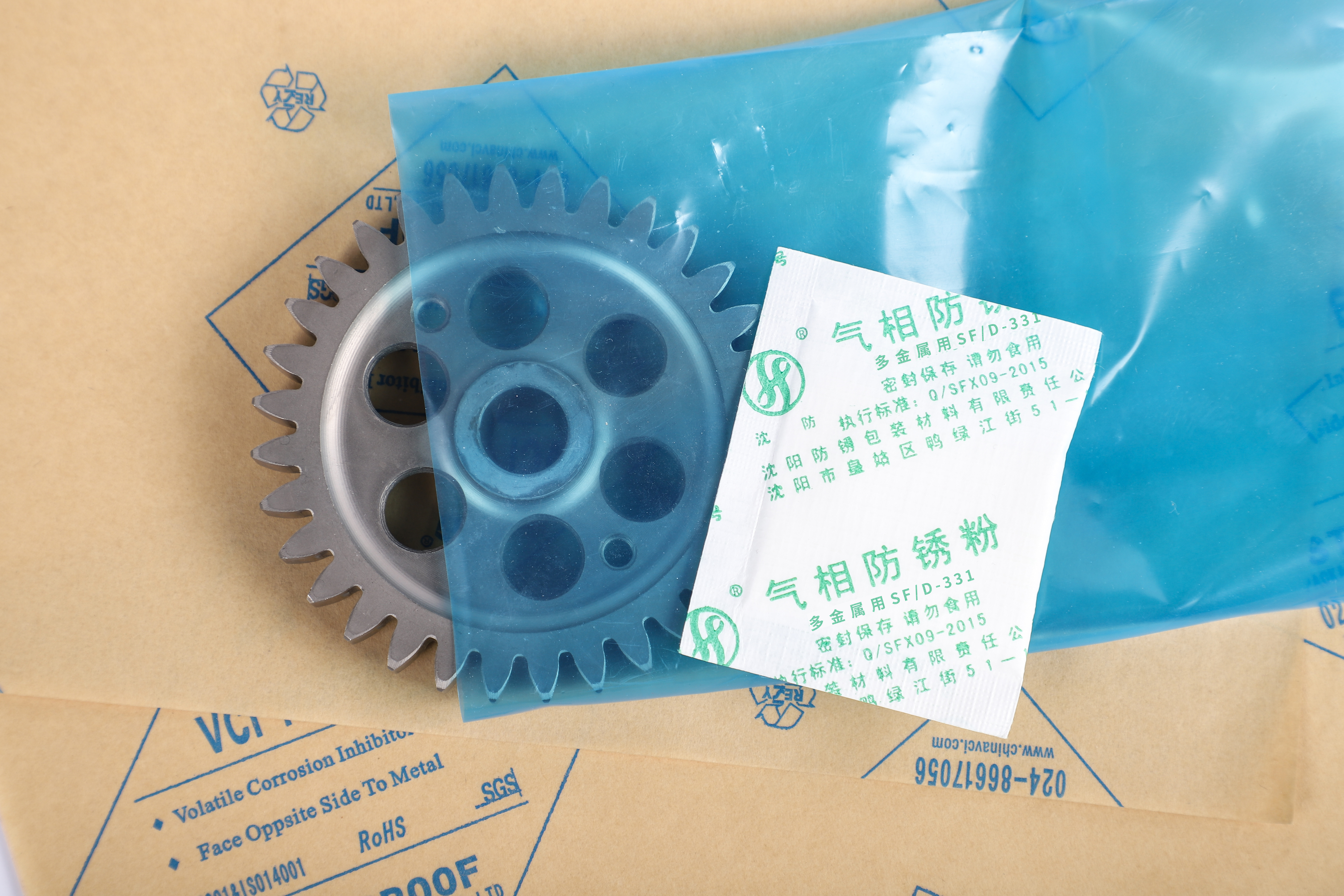
Multi-Layer Protection is More Reliable
In long-term storage or ocean shipping scenarios, single-layer protection is sometimes insufficient. A more reliable approach is to establish a multi-layer rust-proof system. The gear body is wrapped with VCI plastic anti rust film, combined with an outer layer of desiccant or overall sealing treatment, which can simultaneously control both local and overall environmental humidity.
This multi-layered approach can cope with sudden environmental changes, such as container rain during container shipping. When providing solutions to customers, CVCI usually conducts a holistic assessment based on the transportation cycle and destination climate, rather than simply recommending a single product. It is this systematic approach that allows our anti-rust products to maintain stable performance in the export market.
Reference Notes
This article is based on the theory of metal corrosion mechanisms, the principles of vapor phase corrosion inhibition technology, and practical export application experience. Relevant principles can be found in metal corrosion and protection engineering technology literature, as well as research results on the application of vapor phase corrosion inhibition materials.
Welcome to Exchange and Visit
CVCI has long focused on the research and development and production of anti-rust materials, exporting its products to many countries and regions, and has extensive application cases in humid and hot climates. If you are looking for a more reliable solution for the storage and export protection of gears or other transmission components, we sincerely invite you to visit the CVCI factory to understand our production capabilities, R&D system, and real-world application scenarios. Please feel free to contact us at any time to discuss your specific needs.