



Is Using Anti Rust Fluid During Mold Transportation Effective?
2026-01-15 12:01In recent years, there has been a clear trend in the mold industry: whether shipping domestically to customers in other regions or directly exporting to Southeast Asia, the Middle East, and Europe, the transportation chain is getting longer, but rust prevention is often overlooked. The result is that molds are fine at the factory, but problems arise at the customer's site: surface pitting, darkened cavities, seized sliders, rusted guide pins, and a damp smell upon unpacking. These situations are not uncommon in the mold industry, and sometimes they are even more frustrating for customers than incorrect dimensions or poor processing, because it's a problem nobody wants to take responsibility for. Therefore, some companies have started to try using VCI anti rust fluid In China.
Why Molds Particularly Need Rust Prevention
Molds, while seemingly robust and made of steel, are actually very delicate. Mold steel itself has the following characteristics: high strength, high hardness, multiple quenching and tempering treatments, and high surface requirements. In particular, areas such as cavities, parting lines, sliders, and guide pins, once rusted, will directly affect the product: surface roughness, mold sticking, gate marks, reduced brightness, and increased internal stress. Even more troublesome is the high cost of mold repair; it's not something that can be solved by simply applying some oil. Furthermore, the mold transportation scenario itself is extremely risky. Sea transport takes a long time (30-60 days or even longer), exposure to moisture and salt spray during shipping is common, there are large temperature differences between day and night in containers, and delays can occur during port clearance and warehousing. Customer warehouse conditions are often uncontrollable, especially when exporting to Southeast Asian countries such as Vietnam, Malaysia, Thailand, the Philippines, and Indonesia, which are not only humid but also experience high temperatures and heavy rainfall year-round, making them high-risk areas for mold rust. Therefore, mold rust prevention is not optional, but a critical link in the transportation and delivery chain.
Traditional Mold Rust Prevention Methods and Their Shortcomings
In the past, the most common rust prevention methods used by mold companies were: applying rust-preventive oil, applying wax, applying protective film, and using desiccants. These methods are certainly useful, but they also have significant shortcomings: First, rust-preventive oil affects mold testing. Customers must clean the mold before testing, and incomplete cleaning can negatively impact molding. Second, there are blind spots in protection. Molds have complex structures, and it's difficult for oil to cover threaded holes, the inside of cavities, and the gaps between sliders. Thirdly, traditional methods fall short when it comes to export transportation. The marine environment is far harsher than warehousing. Therefore, VCI anti rust fluid In China began to enter the mold industry's field of vision.
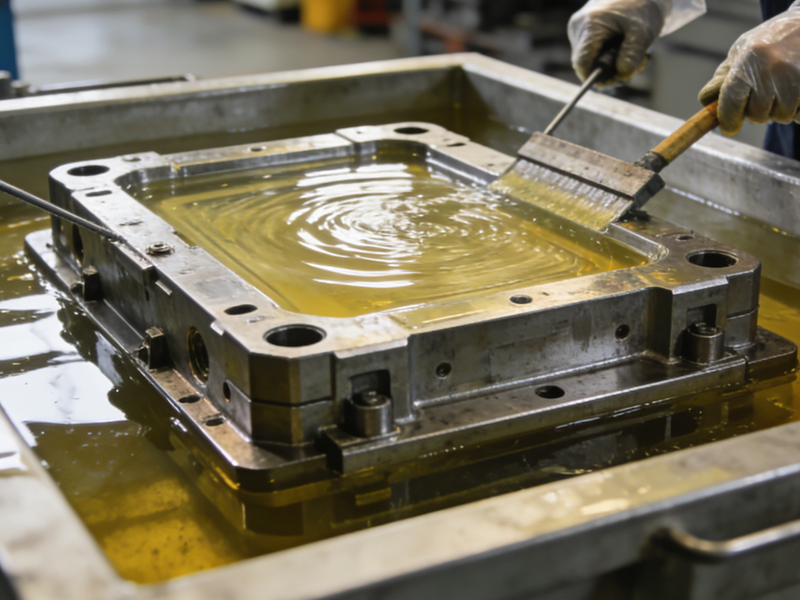
The effect of using VCI anti rust fluid In China during mold transportation
The effect is very good, and it's much more convenient than traditional methods. Customer feedback mainly focuses on three points: 1. Dry and non-greasy. The mold surface is dry after treatment, without a thick oil film, so it won't leave oil all over your hands or attract dust. 2. More comprehensive protection. Because VCI is a vapor-phase rust-inhibiting technology, it can penetrate into the internal spaces of the mold for complete coverage. 3. Ready to use upon unpacking. This is crucial for mold companies, as it eliminates the need for customers to perform secondary cleaning. 4. Stable even during long-term transportation. It is especially suitable for molds transported across oceans and internationally. From the results, the most obvious benefit is the reduction in customer complaints.
The working principle of VCI anti rust fluid In China
VCI stands for Vapor Corrosion Inhibitor. The principle is actually very simple: First step: Volatilization. The VCI components in the rust-inhibiting liquid will slowly volatilize. Second step: Diffusion and filling of the space. A uniform "rust-inhibiting environment" is formed inside the entire mold packaging. Third step: Adsorption onto the metal surface. A molecular-level protective layer invisible to the naked eye is formed. This protective layer blocks moisture, oxygen, salt spray, and corrosive ions, thus interrupting the corrosion process. Therefore, VCI anti rust fluid In China doesn't just coat the mold surface, but protects the entire space.
Features of our VCI anti rust fluid In China
We have a core principle in producing VCI products: we don't pursue promotional effects, but rather actual delivery results. Our VCI anti rust fluid In China has the following main features: compatible with common materials such as mold steel, carbon steel, and alloy steel; free of heavy metals, meeting export environmental protection requirements; long rust-inhibiting period, suitable for export transportation; does not affect subsequent mold testing and production; and has good compatibility with VCI packaging materials. Currently, our products have been exported to multiple countries and regions, with Southeast Asia being the largest market, including Vietnam, Thailand, Malaysia, the Philippines, and Indonesia. Many mold factories have reported that it has solved the problem of molds arriving with rust.